


Artificial Intelligence Teaching Lab
Session 1: What Must Remain Human in Learning?
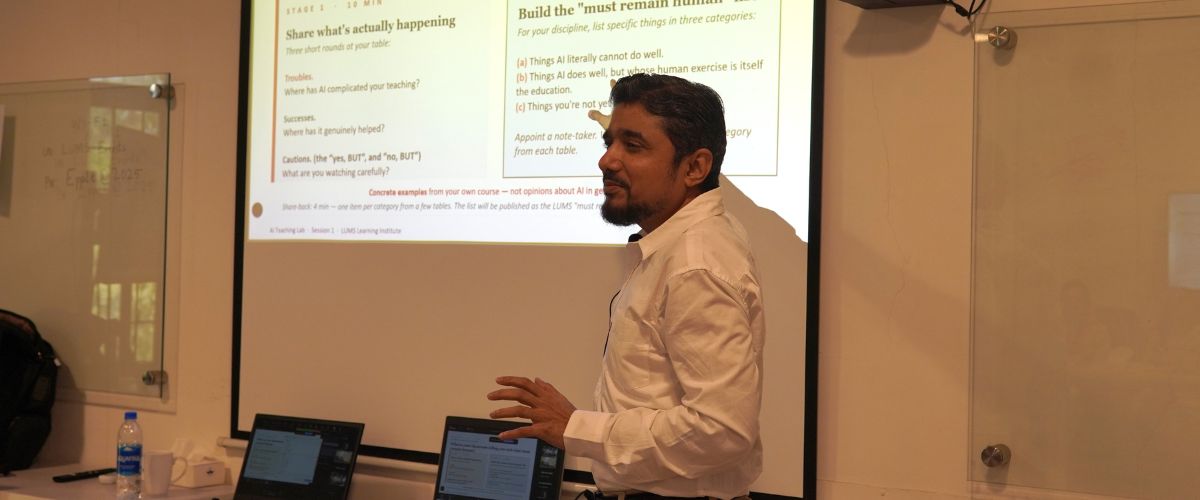
The LUMS Learning Institute (LLI) recently launched its new AI Teaching Lab (AITL) series with an engaging first session led by Dr. Agha Ali Raza. Bringing together faculty members from across disciplines, the session created space for thoughtful reflection on one important question:
As AI makes it easier to generate answers, how do we ensure students are still truly learning?
Rather than focusing only on AI tools, the conversation centered on the learning process itself critical thinking, student effort, and the human side of education that technology cannot replace.

The session was conducted in a hybrid format, with faculty participating both in person at LLI and online from partner institutions, including AROR University of Art, Architecture, Design and Heritage, Sukkur, Sindh and BUITEMS University of Information Technology, Engineering and Management Sciences, Balochistan.
This made the discussion richer, bringing together diverse perspectives from educators across institutions who are all navigating similar questions about AI in higher education.
When Answers Become Easy, What Happens to Thinking?
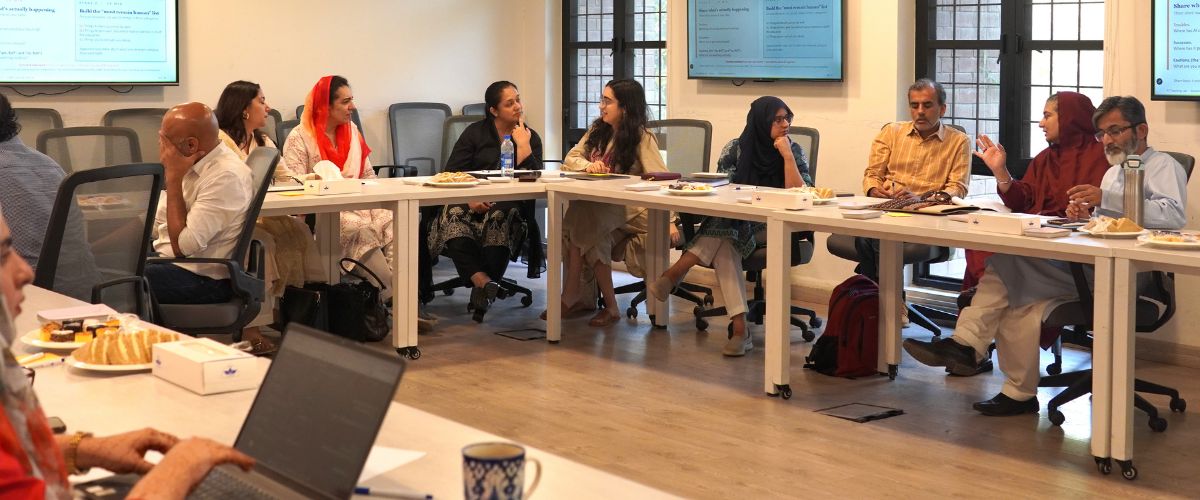
One of the strongest themes of the session was the difference between producing work and learning.
Faculty reflected on how AI tools can help students create polished assignments quickly but raised concerns about whether students are still engaging deeply with ideas, struggling through challenges, and developing independent thought. The discussion highlighted several human skills that remain essential:
- Critical questioning
- Contextual understanding
- Original thinking
- Judgment and decision-making
- Deep engagement with complex ideas
These are the foundations of meaningful learning, and they cannot simply be outsourced.
A Space for Honest Reflection
The AI Teaching Lab is designed as a faculty-centered space for honest conversation, experimentation, and shared learning.
Led by faculty, grounded in classroom practice, and shaped by real teaching experiences, the initiative encourages educators to rethink course design, assessment, and responsible AI use while keeping student thinking, effort, and understanding at the center.
As the series continues, one message from the first session remains clear:
The goal is not just to teach with AI; it is to protect what makes learning human.
Want to join next session?

Connect


